

The states where flood risk is rising fastest, and how many homes aren't insured for it
Floods are the costliest and most common natural disaster in the U.S., causing more than $8 billion in damage in 2024, according to the Federal Emergency Management Agency. $3.8 billion happened in areas not considered high risk. Fathom's U.S. Flood Risk Index [2026] estimates that the average annual exposure of the U.S. population will increase by 72.6% by 2050 from 2020 levels.
In Louisiana, where flood risk is rising the fastest, according to Fathom projections, fewer than 23% of homeowners carry flood insurance; in second-ranked Florida, it's fewer than 15%. In both South Carolina and Texas, fewer than 7% of homes have flood insurance, according to FEMA data.
Risk is rising; Fathom projects that 97% of the U.S. population will be exposed to flood risk by 2050, but flood insurance uptake isn’t keeping up.
Insurance.com broke down which states are seeing the fastest rise in flood risk, and which have the largest flood insurance protection gap.
Key Takeaways:
- Flood risk is rising fastest in Louisiana, Florida and South Carolina, with Louisiana projected to have an increase in annual flood losses of 147% over 30 years.
- Louisiana has the highest percentage of homes insured with National Flood Insurance Program policies of any state, but still has fewer than a quarter of homes (22.9%) insured.
- Florida is at the highest risk of flood losses but has the largest flood insurance protection gap in the nation.
- Climate change is causing rising sea levels and more intense rainfall, driving much of the increased risk of flooding.
Where is flood risk rising the fastest across the US?
Louisiana has the highest projected increase in average annual losses (AAL), at 147% by 2050 from 2020 levels. Florida follows at 73.6%, then South Carolina at 58.4%.
Texas faces a projected AAL increase of 46.6% and had the highest rate of flood losses outside Special Flood Hazard Areas (SFHA) in 2020; at 56%, more than half of flood losses weren’t in high-risk areas, according to Fathom data. Only 6% of single-family homes in Texas had flood insurance in 2026, per FEMA.
All 10 states with the highest projected AAL increases are along the Gulf and Atlantic Coasts. Fathom also projected which states will see the largest increase in population exposure to flooding, with less predictable results. Iowa has the largest predicted increase in population at risk at 276%, followed by Georgia at 236% and North Dakota at 221%.

Insurance.com
Source: Fathom U.S. Flood Risk 2026
Which states have the highest flood risk in 2026?
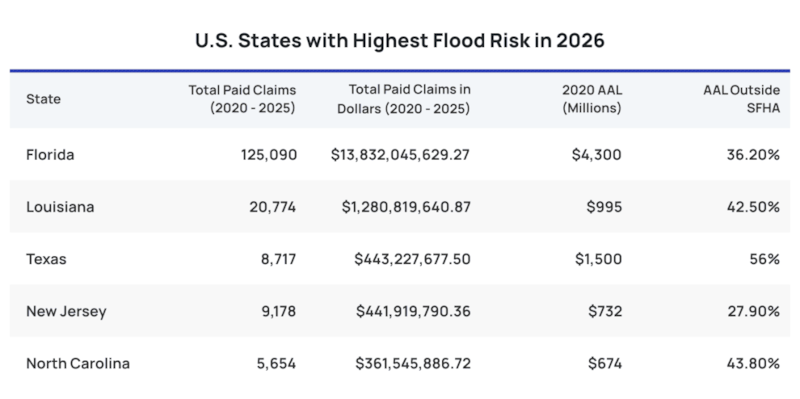
Florida and Louisiana are at the highest risk for floods, followed by Texas, New Jersey and North Carolina. From 2020 to 2025, the NFIP paid the most in flood insurance claims in these states. All five are among the states with the greatest predicted increase in flood losses through 2050, and while year-over-year flood costs vary, these factors are clear predictors of high risk.
Insurance.com
Sources: Floodsmart.gov. Historical Flood Claims Information and Trends, Fathom U.S. Flood Risk 2026
1. Florida
A low-lying peninsula in a high-risk hurricane area, most of Florida is at risk of floods. From 2020 to 2025, only five of Florida's 67 counties had no flood insurance claims under the NFIP; those claims totaled more than $13.83 billion. Florida's AAL in 2020 was the highest in the nation at $4.3 billion, which is expected to increase to $7.5 billion by 2050.
2. Louisiana
Bayous, wetlands, the Gulf of Mexico and the Mississippi all add up to a high flood risk for Louisiana, a situation being worsened by rising sea levels. The state had $1.28 billion in NFIP flood claims paid from 2020 to 2025 and has the fastest-rising risk by a wide margin, with AAL predicted to rise by 147% by 2050.
3. Texas
Hurricane risk along the coast, intense rainfall and flash floods caused by rapid runoff push Texas to the top five highest-risk states. The state had more than $443 million in NFIP claims from 2020 to 2025, and in 2020, 56% of the total $1.5 billion in AAL occurred outside FEMA SFHA areas, where people are not required to have flood insurance.
4. New Jersey
Despite its small size, New Jersey had nearly as high a cost of flood insurance claims as Texas, at $442 million from 2020 to 2025. And while the highest number of flood claims were filed on the coast, flood claims were paid in every county. AAL is predicted to increase by 45.8% from 2020 to 2050, increasing AAL to above $1 billion.
5. North Carolina
Although South Carolina has a greater predicted increase in risk by 2050, North Carolina had more flood claims filed and paid from 2020 to 2025, totaling $362 million, and a higher 2020 AAL of $674 million. Furthermore, more of North Carolina's AAL was outside of high-risk SFHAs, at 43.8%.
Which states have the biggest flood insurance gap?
With a protection gap of nearly $3.67 billion, Florida has the biggest flood insurance protection gap, followed by Pennsylvania ($2.78 billion) and West Virginia ($1.68 billion), based on Fathom’s loss data and FEMA’s NFIP policy count in those states. California and Washington complete the top five.
Mark Friedlander, senior director of media relations for the Insurance Information Institute (Triple-I), said many homeowners underestimate the risk, particularly away from the coast.
“According to a Triple-I consumer survey, most consumers indicated they do not feel flood insurance is necessary and don’t fully understand how significant this growing threat is to their home, especially in inland communities,” he said.
Find your state below to view the protection gap, calculated based on total AAL and the percent of homes in the state with flood insurance according to FEMA.

Insurance.com
Source: Fathom U.S. Flood Risk 2026, National Flood Insurance Program, U.S. Census Bureau
Why flood risk is rising, and why most homeowners aren’t covered
Flood risk is rising due to climate change, which is driving increases in severe weather, population and urban growth, and aging infrastructure.
- Climate change. In coastal areas, rising sea levels due to climate change are increasing tidal and storm-driven flooding, and increases in heavy rainfall are also tied to climate change.
- Population and urban growth. Urban areas are at greater risk of flooding due to poor drainage in concrete-heavy areas.
- Aging infrastructure. The American Society of Civil Engineers [2026] reports that the average age of the more than 92,000 dams in the U.S. is 65 years. 17,000 dams are listed as high-hazard potential.
The flood map coverage gap
Standard homeowners insurance does not cover flooding, but many homeowners aren’t aware that they aren’t covered. Absent the requirement for flood insurance in FEMA-designated high-risk areas, most people don’t buy coverage.
“Coverage is primarily in coastal zones prone to storm surge and where flood insurance is required by mortgage lenders,” Friedlander said.
Fathom’s evaluation of FEMA map coverage indicates that only 60% of the continental U.S. is covered, and only 19% of that coverage uses maps less than 10 years old. That creates a risk evaluation gap and makes it hard for homeowners to understand their true risk.
Cost barriers
The average cost of an NFIP flood insurance policy nationwide is $1,271 a year, according to NFIP data, and the average cost of home insurance is $2,543 a year, based on Insurance.com data, for a combined average of $3,814 a year. Rates trend higher in high-risk coastal areas, leaving homeowners struggling to afford the coverage they need.
However, Friedlander pointed out that in low-risk areas, coverage is much more affordable.
“In most noncoastal areas, you can purchase flood coverage for about $50 a month — much less than home insurance premiums,” he said.
What homeowners in high-risk states should do
In high-risk states, a homeowner's first step is to determine local flood risk using FEMA's flood maps. In a Special Flood Hazard Area, flood insurance generally isn't optional, but many homes outside of these areas need flood insurance as well.
An insurance agent can help you determine your flood insurance needs, including the right amount of coverage.
Where to buy flood insurance: NFIP vs. private policies
Flood insurance is available through the NFIP and private flood insurance companies. Coverage under these two options differs: NFIP limits building coverage to $250,000 and contents to $100,000, while private flood insurance limits vary and are often much higher. Choose the policy that best meets your coverage needs and budget.
“With the growing private flood insurance market (nearly 80 carriers writing coverage), there are numerous options for obtaining coverage in many areas. Private policies offer more robust coverage, including much higher limits than NFIP. Private policies also typically include additional living expenses (temporary living if displaced by flood damage), which is not included in NFIP policies,” Friedlander said.
An NFIP policy has a 30-day waiting period in most cases, while private flood insurance waiting periods vary. Both options have moratoriums on new policies when a storm is approaching; have your coverage in place well ahead of storm season.
How much is flood insurance in high-risk states?
The average cost of an NFIP policy in Louisiana, where risk is projected to rise the most, is $1,170 a year. In Florida, it’s $1,421 a year, and in South Carolina, $1,117 a year, according to NFIP data. FEMA’s Risk Rating 2.0, initiated in 2022, changed the methodology for calculating flood insurance rates, expanding it to use risk factors beyond location on a flood plain. In high-risk areas, rates have increased.
FAQ: Flood risk and flood insurance
Which state has the highest flood risk in the U.S.?
Florida, Louisiana, South Carolina and Texas are all among the states with the highest flood risk. Flood risk varies by county, so entire states are not high-risk; however, Florida and Texas have the most counties with FEMA SFHA designations, making them high-risk.
Is flood risk increasing across the U.S.?
Yes. Flood risk is increasing nationwide, with an estimated increase in annual losses of 72.6% by 2050, according to Fathom. Climate change, urban growth and aging infrastructure are all contributing to the increased risk.
Does homeowners insurance cover flooding?
No. Homeowners insurance excludes damage caused by overland flooding, including storm surges and flash floods caused by heavy rainfall. A separate flood insurance policy is required and can be purchased through the NFIP or private flood insurance companies.
How many homes in the U.S. have flood insurance?
Nationwide, the NFIP reports that about 3% of single-family homes have flood insurance through its program, which provides the majority of flood insurance coverage in the U.S.
What is the NFIP and who needs it?
The NFIP is the National Flood Insurance Program, run by FEMA. It provides residential and commercial flood insurance policies nationwide. If you live in a high-risk flood area, you need an NFIP policy to cover flood damage; private flood insurance is available as an alternative in some areas.
How much does flood insurance cost?
The average cost of an NFIP flood insurance policy nationwide is $1,271 a year, but rates vary by location and coverage amount. Policies in high-risk areas are more expensive, while low-risk areas have lower rates.
Can I get flood insurance if I’m not in a flood zone?
Yes. You can buy flood insurance regardless of how FEMA designates your location. FEMA estimates that 29% of flood insurance claims come from policies outside of Special Flood Hazard areas.
Methodology
Flood insurance policy single-family home take-up by state percentage was calculated using the NFIP Policies in Force by Occupancy Type/Flood Zone data and U.S. Census Bureau Table B25024: Units in Structure data, dividing the number of residential policies in force by the total number of single-family units in the census.
The calculated inverse of the take-up rate was subtracted from one to estimate the percentage of homes uninsured for the protection gap. This percentage was multiplied by the 2020 AAL figures by state to estimate the dollar-amount protection gap. For these estimations, each home is treated as having an equal expected loss
This story was produced by Insurance.com and reviewed and distributed by Stacker.